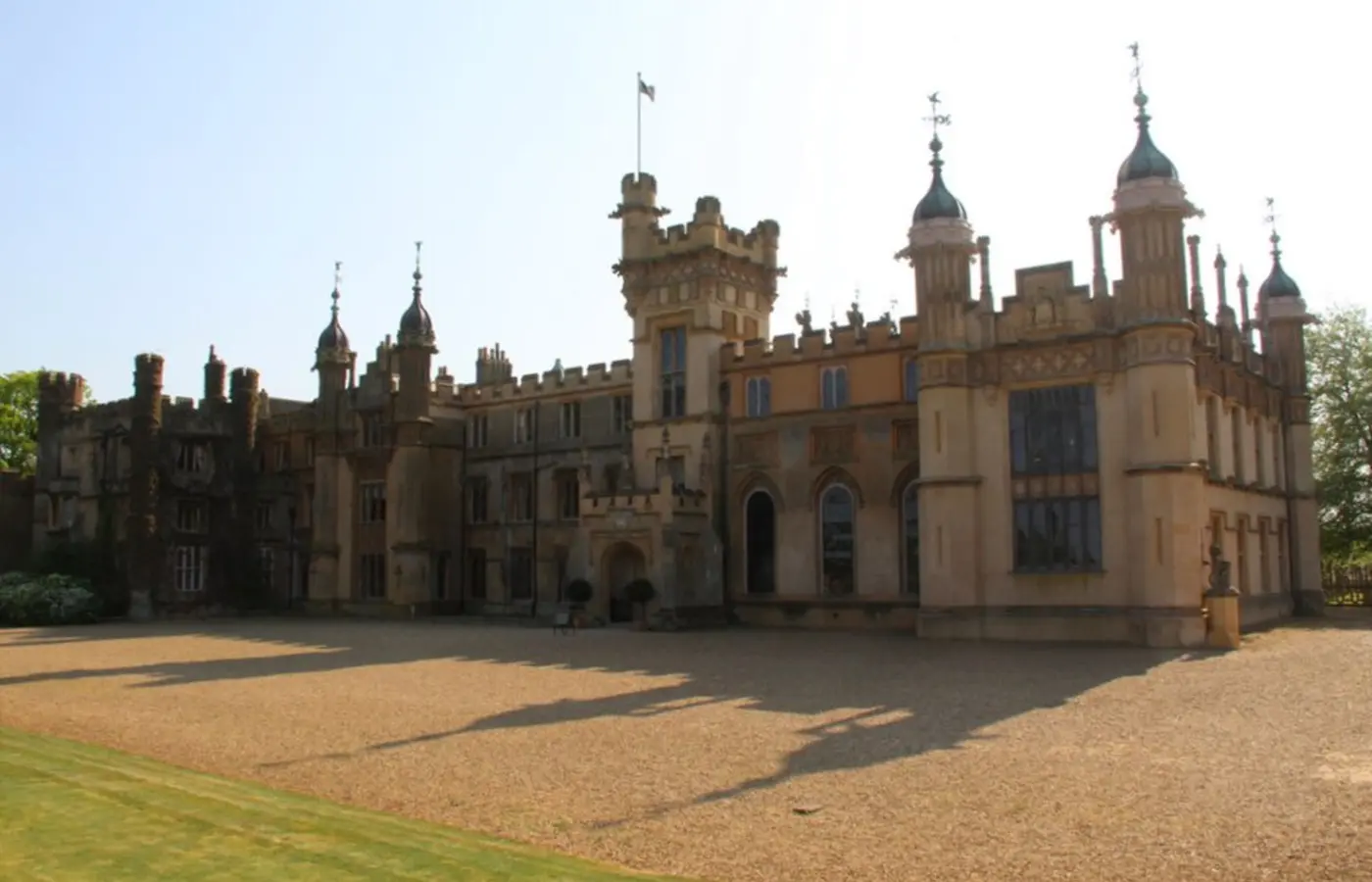
Quitewell Hall in The Dark Rider
Knebworth House supplies the Gothic exterior of Quitewell Hall in The Dark Rider. That specific connection is the starting point for this visit: look for the house’s outline and architectural details when comparing the real building with the episode. The fictional estate belongs to the story, while Knebworth has a much longer history of its own. Its elaborate appearance gives the camera an immediately recognisable country-house setting.
Open the linked episode for its cast and premise, then return to the exterior view here if you want to compare locations without opening the solution. The filming connection identifies the house as a particular screen setting. For a day out, decide separately whether you want to explore the house, gardens or wider park. Those choices determine which official visitor information you need before booking.
How the real house acquired its appearance
Knebworth’s own history describes a house repeatedly reshaped by the Lytton family. Sir Robert Lytton bought the manor in 1490, and a courtyard house developed around the surviving earlier fabric. Elizabeth Bulwer Lytton later reduced its scale by demolishing three sides in 1813. The building seen today therefore carries the results of several decisions about what to retain and what to remove.
Edward Bulwer Lytton subsequently transformed the remaining house with the turrets, decorative creatures and Gothic detail that make it so distinctive. Later work added further height and a watchtower, while Edwin Lutyens advised the next generation on alterations. Read that sequence before your visit and the building becomes more than a suitably ominous television façade: its changing outline tells a separate family and architectural story.
Confirmed · Knebworth House history ↗
Gardens beyond the screen exterior
The estate describes gardens reaching back at least to the seventeenth century, with much of the present arrangement shaped in the Edwardian period. Lutyens replaced ornate Victorian features with lawns and avenues of pollarded lime trees. A later herb garden was planted in 1982 using a Gertrude Jekyll design from 1907.
Those layers offer a useful counterpoint to the house exterior. You can choose to spend part of a visit looking at the garden’s composition rather than treating every view as a filming clue. Compare the formal arrangement with the decorative house, and use the official garden information to decide which areas interest you. The garden history is a reason to explore the real property in its own right.
Confirmed · official garden history ↗
Access and photography before you book
Knebworth’s FAQs say visitor parking is available without an additional parking charge, with locations varying on special event days. They permit visitor photographs of the exterior and grounds, while restricting photography inside the house to camera phones without flash. Tripods, lighting equipment and drones are prohibited. Read the current rules again before taking equipment with you.
The same page distinguishes an ordinary visit from commercial filming or photography, which must be arranged with the estate. A remembered television shot is a good reason to look closely at a façade; it does not change the venue’s own rules. Check the opening calendar and the admission option for the areas you want to see before planning an overnight stay.
Confirmed · official FAQs, checked 18 October 2026 ↗
Planning for particular access needs
The official access page says the house has no lift to its first floor. Ground-floor rooms are accessible to wheelchairs, with restrictions on electric wheelchairs and mobility scooters inside the house and exhibition. Consult the detailed access information and contact the estate about your own requirements before purchasing tickets. The facilities appropriate to a garden visit may differ from those needed for an interior tour.
Confirmed · official accessibility information, checked 18 October 2026 ↗